Guide
Flexible flat cable basics for OEMs
Why FFC exists, where it beats discrete wire, and how SEPM’s Flat Component Division frames board-to-board and mass-termination use cases.
28 March 2026
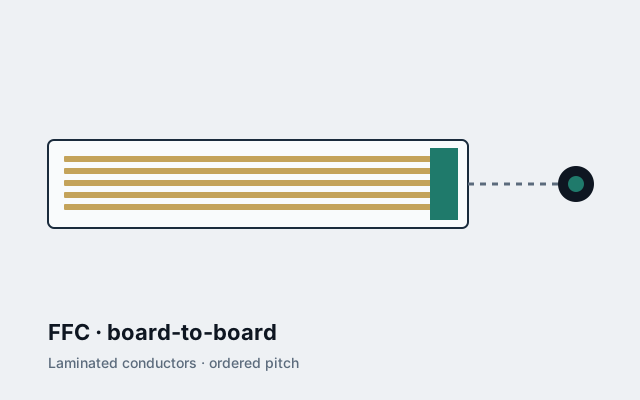
Flexible flat cable (FFC) packs many conductors into a thin laminated ribbon so designers can terminate dozens of signals in one connector stroke. SEPM’s Flat Component messaging emphasises simplicity and wiring efficiency for computers, AV gear, office equipment, and game consoles — categories that historically demanded orderly interconnects without the bulk of round-wire bundles.
What problem FFC solves
Discrete wire harnesses are flexible and familiar, but they grow messy as pin counts rise. Rigid-flex PCBs solve density elegantly yet raise tooling cost and lead time. FFC sits in the middle: conductors stay in a fixed pitch, the cable folds into tight spaces, and assembly can mate an entire array at once.
Classic dynamic examples include trailing cables on printer carriages — the ribbon flexes thousands of times while keeping pin order intact. Board-to-board jumpers in consumer and industrial electronics use the same idea over shorter, mostly static spans.
Anatomy of a typical FFC
- Flat rectangular copper conductors at a defined pitch
- Insulation films laminated top and bottom
- Prepared ends for connectors (sometimes plated)
- Optional shield layers for EMI
SEPM markets this laminated idea under the SUMI-CARD™ brand and adds variants for plating, shielding, fine pitch, temperature/humidity, and halogen-free goals.
Selection checklist
- Pitch — Match the connector (including specialty 0.5 mm options).
- Length & fold plan — Avoid sharp creases outside the manufacturer’s bend radius guidance.
- Flex life — Distinguish static interconnect from dynamic trailing duty.
- Environment — Temperature, humidity, and substance restrictions (halogens).
- EMI — Decide whether shielded FFC is required.
When SEPM’s story is useful
If you are sourcing FFC from Malaysia, SEPM’s published capacity path — FFC start in M1 (1993), later plating and STC expansions — signals a long FFC heritage rather than a one-off SKU. Still confirm current constructions with SEPM sales; archived brand pages are not a live inventory.
Continue with SUMI-CARD pitch options or the Flat Component Division overview.